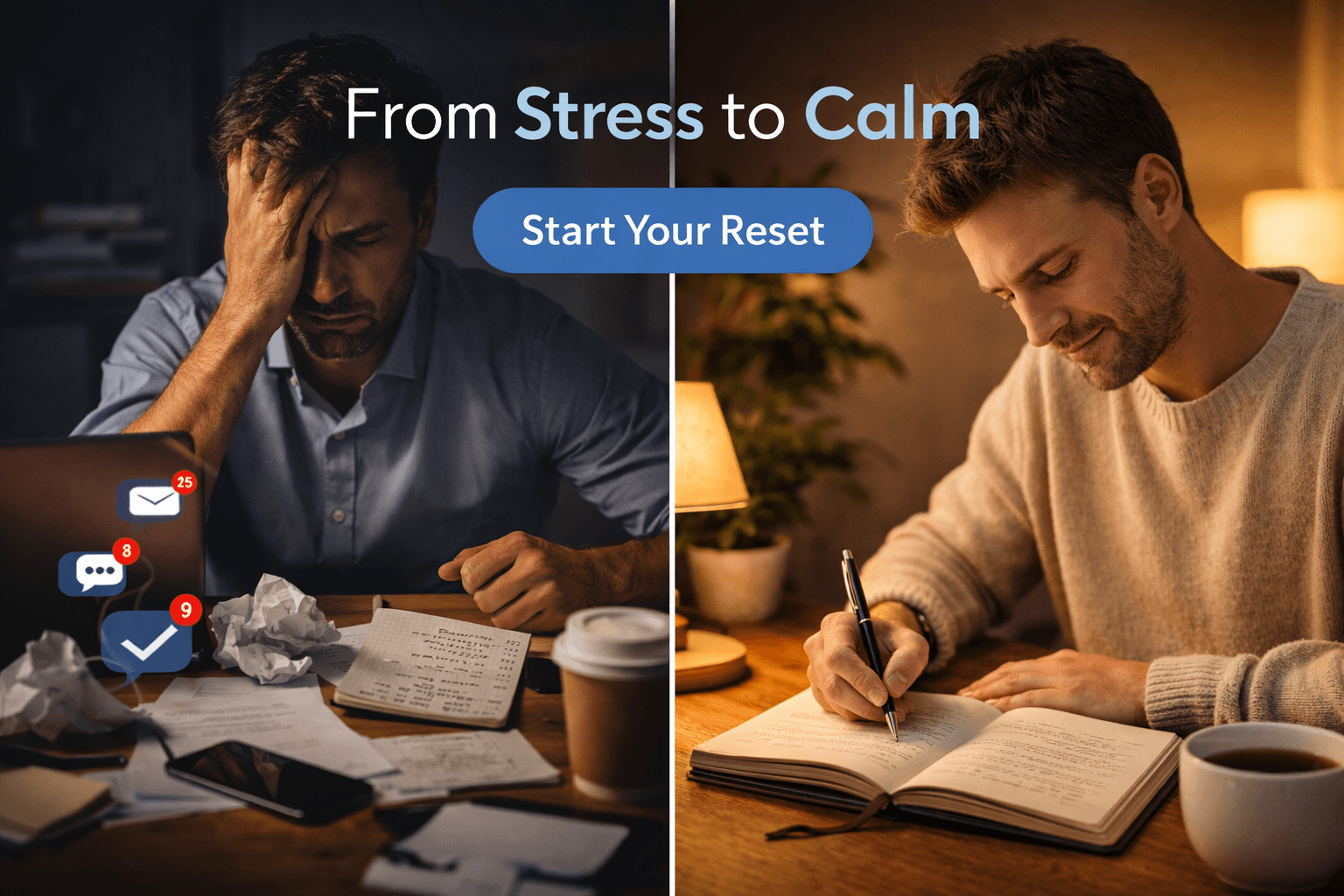
Let me be straight with you. I’ve been running online businesses and doing affiliate marketing for over a decade. I’ve had product launches flop overnight, had Google algorithm updates wipe out 60% of my traffic in a single day, and dealt with the kind of financial uncertainty that makes your stomach turn at 2 AM.
Stress? I know it intimately.
And here’s what I learned the hard way — you cannot build anything sustainable if your mind is falling apart. Your content suffers. Your decisions get cloudy. Your relationships crack. I’ve watched talented people quit because they didn’t know how to stay mentally healthy during stressful times. I almost became one of them.
So this isn’t a generic “take a deep breath and journal” article. This is what actually works — backed by science, tested in the real world, and written by someone who’s had to apply every single one of these strategies while under serious pressure.
Why Mental Health Gets Ignored During Stress
Here’s the irony nobody talks about: the moment you need to protect your mental health the most is exactly when you’re least likely to do it.
When you’re stressed whether it’s financial pressure, a health scare, a business crisis, or a global event your brain goes into survival mode. The prefrontal cortex ( gets suppressed. The amygdala (fear, fight-or-flight) takes over.
You stop sleeping well. You skip exercise. You eat garbage. You scroll your phone at midnight. And all of those behaviors make the stress worse — not better.
It’s a vicious loop. And breaking that loop requires deliberate action, not willpower alone.
1. Acknowledge the Stress — Stop Pretending You’re Fine

The first step to learning how to stay mentally healthy during stressful times is radical honesty with yourself.
I spent years saying “I’m fine, I just need to work harder.” That is one of the most damaging lies I told myself. Suppressing stress doesn’t make it disappear — it goes underground and shows up as anxiety, burnout, irritability, or physical illness.
What to do instead:
- Name what you’re feeling. Literally say it out loud or write it down: “I’m overwhelmed because I have three deadlines, my income dropped, and I haven’t slept properly in a week.”
- Use a simple 1–10 stress scale daily. Just tracking it creates awareness.
- Stop measuring your worth by your productivity during hard times.
Research published in the Journal of Personality and Social Psychology found that people who label their emotions with specific words (emotional granularity) experience lower emotional reactivity. It’s not weakness — it’s neuroscience.
2. Protect Your Sleep Like It’s Your Most Valuable Asset
In affiliate marketing, we talk about protecting your traffic sources, your email list, your income streams. Sleep is the foundation underneath all of those.
When you’re sleep-deprived, your cortisol (stress hormone) stays elevated. Your decision-making tanks. Your creativity disappears. I’ve published blog posts, run ad campaigns, and written emails while sleep-deprived — and I can tell you, every single one of them was worse than it should have been.
Practical sleep hygiene for high-stress periods:
- Set a non-negotiable sleep window (mine is 10:30 PM — 6:30 AM, no matter what’s on fire)
- No screens 45 minutes before bed — yes, even if you’re “just checking stats”
- Keep your room cool (around 65–68°F / 18–20°C)
- Consider magnesium glycinate — it’s one of the most research-backed supplements for sleep quality and stress reduction
- If your mind races at night, do a “brain dump” — write every worry down before bed so your brain doesn’t have to hold it
Sleep isn’t lazy. Sleep is how your brain literally flushes out toxic metabolic waste through the glymphatic system. Miss it, and you’re not just tired — you’re cognitively impaired.
3. Move Your Body — Even When You Don’t Feel Like It

I used to skip workouts when I was “too busy” or “too stressed.” Turns out, that’s exactly backwards.
Exercise is the single most effective natural antidepressant and anti-anxiety tool available to humans. It’s not a nice-to-have. It’s a biological necessity, especially when cortisol levels are high.
Here’s what exercise actually does during stress:
- Releases endorphins and BDNF (brain-derived neurotrophic factor) — literally grows new brain cells
- Burns off excess cortisol and adrenaline
- Improves sleep quality (which reduces stress — notice the chain)
- Gives you a sense of agency and control when everything else feels chaotic
You don’t need a gym or an hour a day. A 20-minute brisk walk every morning has been shown in multiple studies to significantly reduce anxiety and depressive symptoms. I do a morning walk every single day — no podcast, no phone calls. Just walking and thinking. It’s worth more to my mental state than almost any productivity hack I’ve ever tried.
4. Build a Ruthless Information Diet
This one changed my life more than I expected.
When you’re stressed, consuming more news, social media, and fear-based content makes it dramatically worse. Your nervous system cannot distinguish between a real threat in front of you and a news story about a threat 5,000 miles away. It reacts to both the same way.
I track my business metrics obsessively — that’s part of the job. But I had to learn to time-box my information consumption:
- Check news once a day, for no more than 15 minutes
- Unfollow or mute accounts that consistently spike your anxiety (even if they’re “informative”)
- Replace doom-scrolling time with something that puts something in rather than draining you — a podcast you enjoy, a book, music
Think of your attention like your ad budget. You wouldn’t just let it bleed out randomly. You’d allocate it strategically. Do the same with what you let into your mind.
5. Reconnect with People — Isolation Makes Everything Worse

Solo entrepreneurship and remote work have a dark side — isolation. And when you’re already stressed, the temptation is to go quiet, to not burden people, to just grind through it alone.
I’ve done this. It doesn’t work.
Human connection is one of the most powerful buffers against chronic stress. The Harvard Study of Adult Development — one of the longest-running studies on human happiness — found that close relationships are the single biggest predictor of both happiness and health, more than wealth, fame, or success.
During high-stress periods:
- Schedule at least one meaningful conversation a week — a call, a coffee, a walk with someone you trust
- Be honest with the people close to you about what you’re going through
- If you don’t have that kind of support network, consider a therapist, a mastermind group, or even a community forum in your niche
In the affiliate space, my network of fellow marketers who I can be honest with has been invaluable — not for business tactics, but for the mental health side of things. Someone who gets the unique stress of income uncertainty, algorithm changes, and the loneliness of online business is worth their weight in gold.
6. Reframe Control — Focus Only on What You Can Actually Move
One of the most mentally exhausting things you can do is spend energy worrying about things you have no control over.
I learned this principle from Stoicism — specifically from Marcus Aurelius and Epictetus — and it transformed how I handle business setbacks. When a Google update tanks my rankings, I can’t control the algorithm. I can control how quickly I audit my content, diversify my traffic sources, and adapt my strategy.
The practical application:
- Write down everything stressing you out
- Draw two columns: “Things I can control” and “Things I cannot control”
- Spend your energy entirely on the first column. Let the second one go.
This isn’t toxic positivity. It’s mental resource management. You have a finite amount of cognitive and emotional energy per day. Spending it on the uncontrollable is like pouring water into a bucket with a hole.
7. Create Small Wins Every Single Day

Stress thrives in chaos. Structure is its antidote.
When big goals feel impossible and everything seems out of control, small wins restore a sense of agency. This is backed by Teresa Amabile’s “Progress Principle” research from Harvard — even minor progress on meaningful work triggers positive emotion and reduces stress.
Every day, I set three non-negotiable tasks — small enough to complete, meaningful enough to matter. When I check them off, there’s a real neurological reward. Over time, those small wins compound into momentum.
Don’t wait for the big breakthrough to feel good. Feel good about the small move today.
8. Consider Professional Support — It’s Not a Last Resort
I want to address this directly because there’s still stigma around it, especially in high-performance, entrepreneurial circles.
Therapy is not a crisis tool. It’s a performance tool.
Some of the most successful people I know — marketers, founders, creators — work with therapists or coaches not because they’re broken, but because they want to perform at a high level sustainably.
If you’re experiencing persistent anxiety, low mood, inability to focus, or physical symptoms of stress (headaches, chest tightness, digestive issues) — talking to a licensed therapist or your doctor is not weakness. It’s the smartest ROI on your time and money you can make.
A Note on Supplements and Tools Worth Exploring
(This is not medical advice — always consult your doctor.)
Over the years I’ve experimented extensively and a few things consistently support mental health during stress:
- Ashwagandha (KSM-66 form): Well-researched adaptogen shown to reduce cortisol
- Magnesium glycinate: Supports sleep and nervous system regulation
- L-theanine: Promotes calm focus without sedation great with morning coffee
- Omega-3 fatty acids: Extensively linked to reduced depression and anxiety symptoms
FAQ: How to Stay Mentally Healthy During Stressful Times
Q1: How do I stay mentally healthy when I feel completely overwhelmed? Start with the smallest possible action — drink a glass of water, take five deep breaths, write one sentence about how you feel. You don’t have to fix everything at once. Overwhelm shrinks when you break it into the next single step.
Q2: Can you stay mentally healthy without therapy? Many people do, yes through consistent sleep, exercise, social connection, and mindfulness practices. But therapy dramatically accelerates the process and gives you tools you can’t always develop alone. Think of it like trying to grow a business without any tools or mentors possible, but much harder.
Q3: How long does it take to feel better when you start these habits? Most people notice a meaningful shift in 2–3 weeks of consistent practice. Sleep and exercise improvements tend to show results fastest. Don’t expect overnight transformation expect gradual, compounding improvement.
Q4: What’s the single most impactful thing I can do for my mental health during stress? If I had to pick one: sleep. Everything — mood, decision-making, emotional resilience, physical health — depends on it. Fix your sleep first.
Q5: Is it normal to feel mentally worse before feeling better when working on stress? Yes, absolutely. When you start acknowledging stress instead of suppressing it, it can feel more intense initially. This is normal it’s part of the processing. Stick with the habits and it gets better.
Q6: How do I stay productive while also protecting my mental health? These are not opposites they’re aligned. The habits above (sleep, movement, boundaries on information) increase your productive capacity. Burning yourself out is not productivity; it’s eating tomorrow’s energy today.
Final Thoughts: Mental Health Is a Strategy, Not a Luxury
After everything I’ve been through the failed launches, the overnight traffic drops, the financial stress, the uncertainty the biggest lesson is this:
Your mind is your most valuable business asset. Protect it like one.
The world will always have stress in it. Algorithms will change. Markets will crash. Life will throw curveballs. The people who endure and succeed aren’t the ones who avoided stress — they’re the ones who built systems to stay mentally healthy during stressful times, and kept showing up anyway.
Start with one thing from this list today. Not tomorrow. Today