Let me be real with you for a second.
I’ve been in the fitness and wellness niche for over years. I’ve reviewed hundreds of workout programs, promoted dozens of fitness products, and talked to thousands of people who are exactly where you might be right now overweight, a little overwhelmed, and genuinely unsure where to start.
And the number one mistake I see beginners make? They find some intense 60-minute HIIT program on YouTube designed for someone who’s already fit, try it for three days, and give up because their knees are screaming and their motivation has flat lined.
That’s not a “you” problem. That’s a program problem.
This article is different. I’m going to give you a full body workout routine for overweight beginners that is actually built for your body, your fitness level, and your lifestyle — right now, today.
Let’s get into it.
Why Most Beginner Workout Plans Fail Overweight People
Before I hand you the routine, you need to understand why generic beginner workouts often don’t work for people carrying extra weight.
First, joint stress is a real issue. When you’re overweight, your knees, hips, and ankles are already under significantly more load than average. Throwing high-impact moves like burpees or box jumps into the mix right away is a recipe for injury.
Second, cardiovascular capacity is different. Your heart and lungs need time to adapt. Starting too intense too fast leads to breathlessness, discouragement, and burnout.
Third — and this one nobody talks about enough — recovery takes longer. Your body needs more time between sessions when it’s in the early stages of adaptation.
A well-designed full body workout routine for overweight beginners accounts for all of this.
What You Need Before You Start
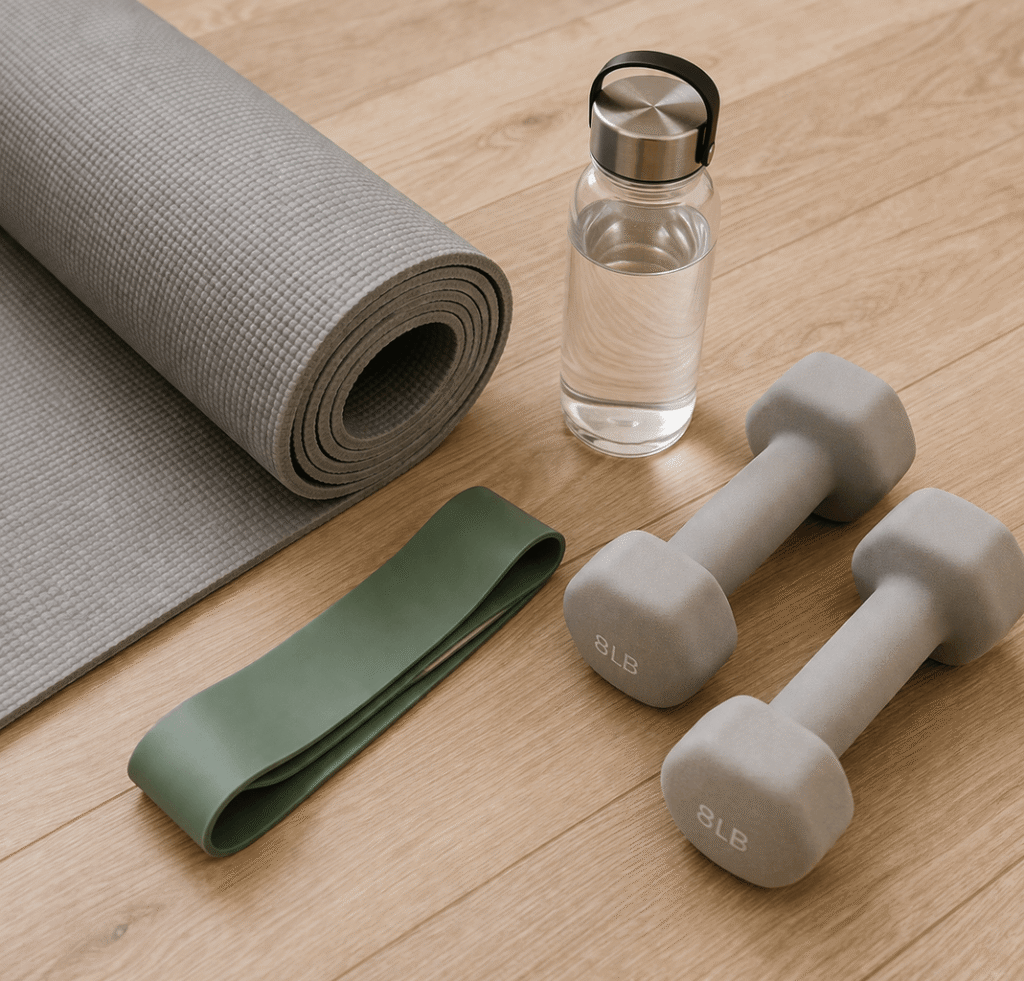
One of the biggest myths in fitness is that you need expensive equipment or a gym membership to get results. You don’t.
Here’s what I’d recommend having:
- A yoga mat (protects your joints on hard floors)
- A pair of light dumbbells (5–10 lbs to start) — these are optional for the first few weeks
- A resistance band (great for low-impact strength work)
- Comfortable, supportive shoes (this matters more than people realize)
- A water bottle and some space — that’s it
The Full Body Workout Routine for Overweight Beginners
This is a 3-day per week routine. You’ll do it on non-consecutive days — for example, Monday, Wednesday, Friday. This gives your body the recovery time it actually needs.
Each session should take you 25–35 minutes to complete. No more. Consistency beats intensity every single time when you’re just starting out.
Warm-Up (5 Minutes — Never Skip This)
Do each of these for 45 seconds:
- Marching in place – gets your heart rate up gently
- Arm circles – forward and backward, loosens the shoulders
- Hip circles – hands on hips, rotate slowly
- Ankle rolls – reduces joint stiffness
- Standing torso twists – warms up your spine
The Main Workout
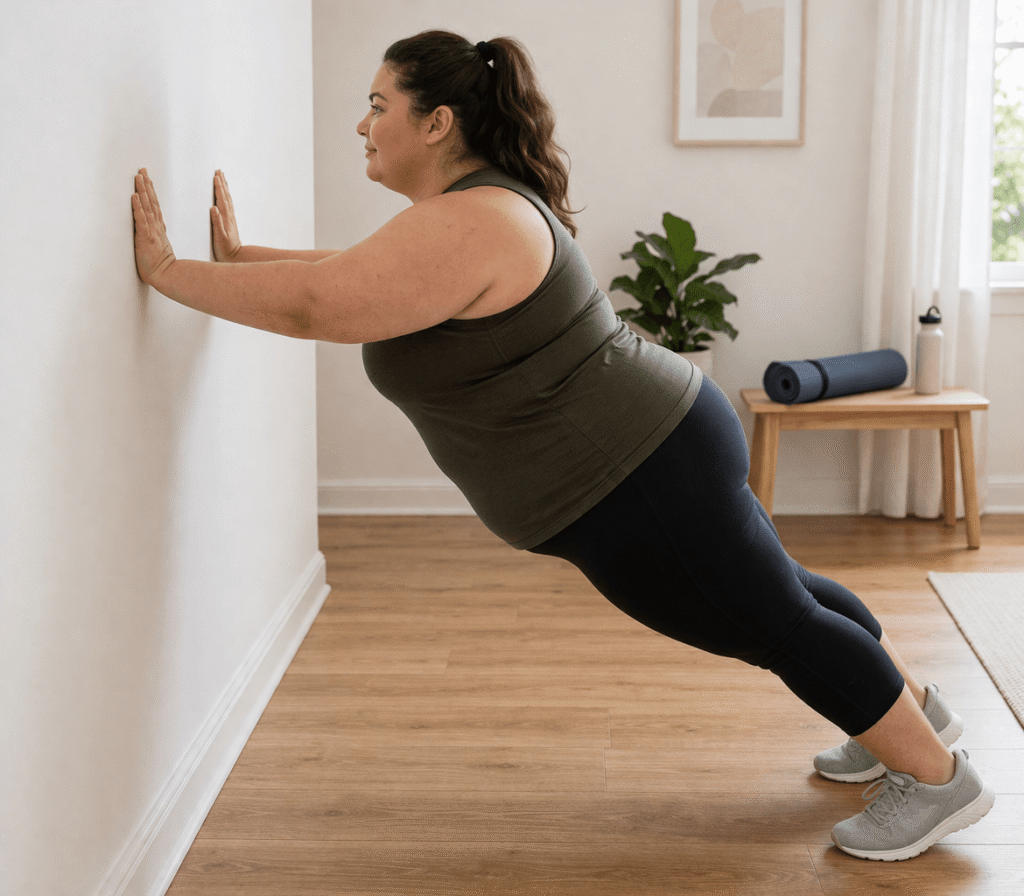
Exercise 1: Wall Push-Ups
Sets: 3 | Reps: 10–12 | Rest: 60 seconds
Regular floor push-ups place enormous stress on the wrists and shoulders when you’re carrying extra weight. Wall push-ups remove that issue entirely while still building real chest, shoulder, and tricep strength.
How to do it: Stand an arm’s length from a wall. Place your palms flat on the wall at shoulder height and width. Slowly bend your elbows to bring your chest toward the wall, then push back. Keep your body in a straight line the whole time — don’t let your hips sag.
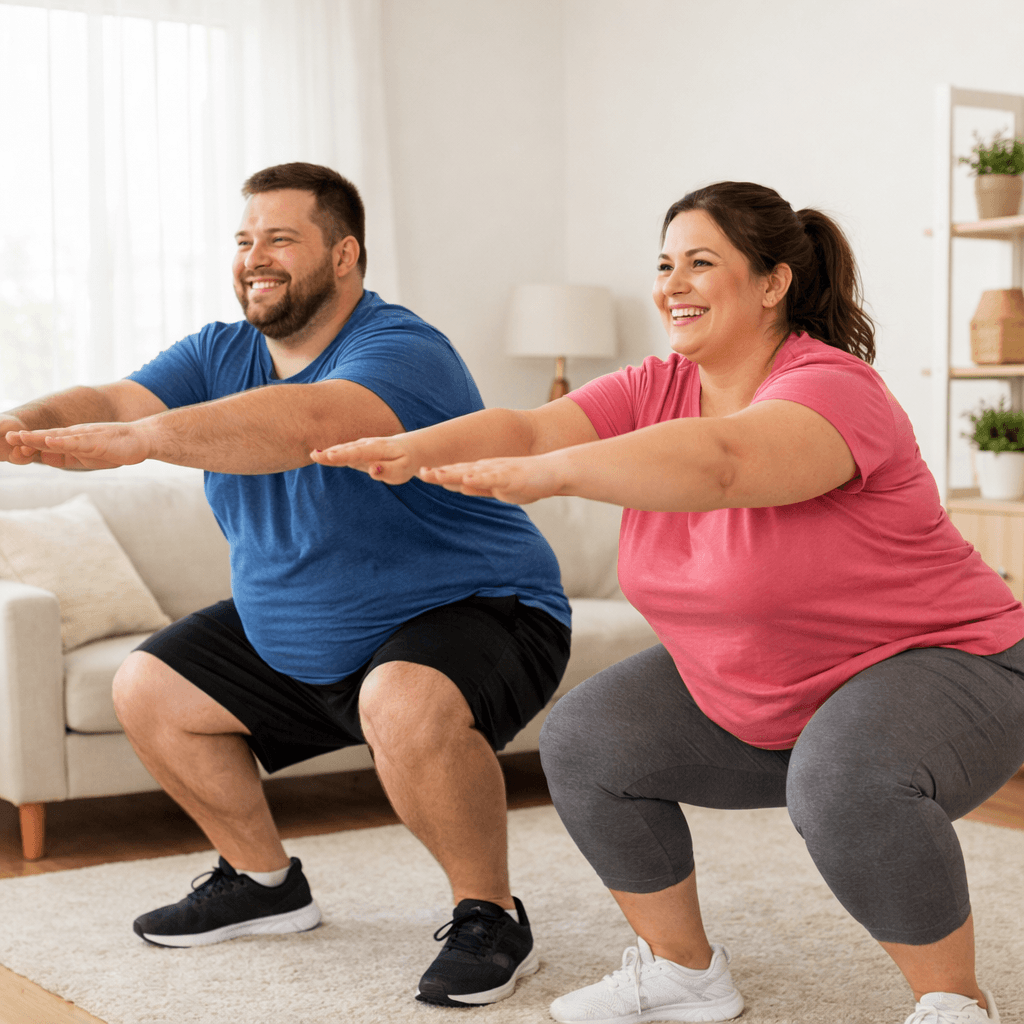
Exercise 2: Chair-Assisted Squat
Sets: 3 | Reps: 10–12 | Rest: 60 seconds
This is probably the single most important exercise in this entire routine. Squatting builds the quads, glutes, and hamstrings — your largest muscle groups — which means it burns the most calories and builds the most functional strength.
How to do it: Stand in front of a sturdy chair with feet shoulder-width apart. Slowly lower yourself as if you’re about to sit, hovering just above the seat, then push back up through your heels. Use the chair as a safety net, not a crutch.
Exercise 3: Standing Hip Hinge (Deadlift Pattern)
Sets: 3 | Reps: 10 | Rest: 60 seconds
This teaches your body the hinge movement, which is critical for back health and glute activation. No weights needed to start — just your bodyweight.
How to do it: Stand with feet hip-width apart, soft knees. Push your hips back (not down) while keeping your chest up and back flat. Feel a gentle stretch in your hamstrings, then squeeze your glutes to stand back up. Think: “close a car door with your butt.”
Exercise 4: Seated Resistance Band Row
Sets: 3 | Reps: 12 | Rest: 60 seconds
Upper back strength is incredibly underrated for overweight beginners. Strong upper back muscles improve posture (which makes you look and feel better instantly) and help prevent shoulder issues down the line.
How to do it: Sit on the floor or edge of a chair, loop a resistance band around your feet. Sit tall, pull both ends of the band toward your hips, squeezing your shoulder blades together. Slowly return to start.
Exercise 5: Glute Bridge
Sets: 3 | Reps: 12–15 | Rest: 60 seconds
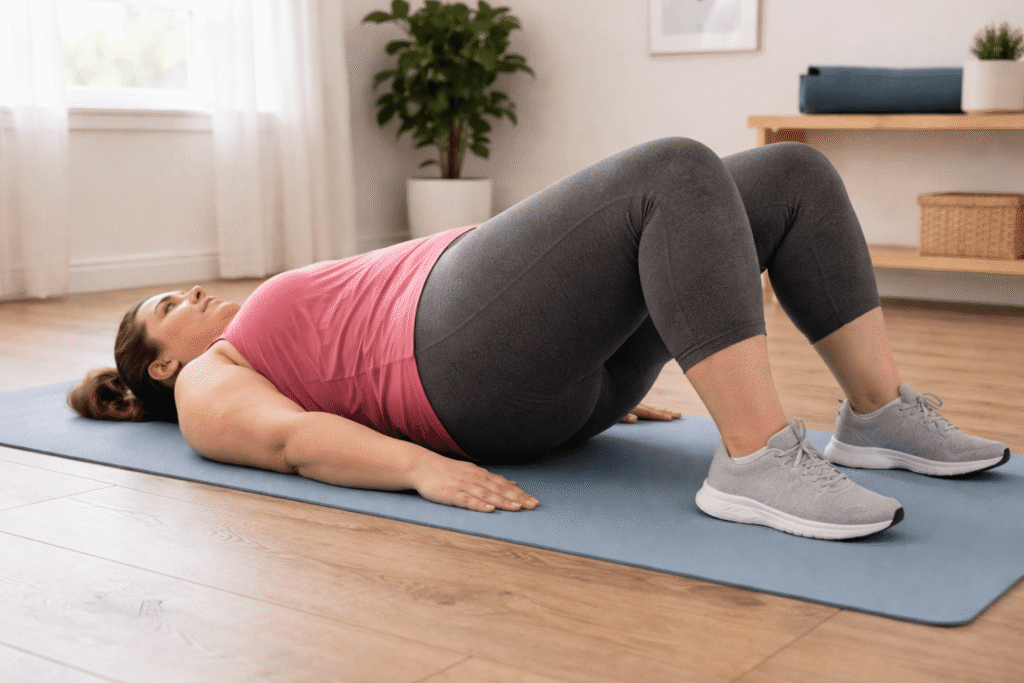
This is a floor exercise that is surprisingly effective and extremely joint-friendly. It works your glutes, hamstrings, and lower back all at once.
How to do it: Lie on your back with knees bent, feet flat on the floor about hip-width apart. Press through your heels to lift your hips toward the ceiling, squeezing your glutes at the top. Hold for 1–2 seconds, then lower slowly.
Exercise 6: Standing Calf Raises
Sets: 2 | Reps: 15 | Rest: 45 seconds
Simple, effective, and low-impact. Use a wall or chair for balance if needed.
Exercise 7: Dead Bug (Core Work)
Sets: 2 | Reps: 8 per side | Rest: 60 seconds
Crunches put unnecessary stress on the neck and spine. The dead bug is far safer and more effective for beginners.
How to do it: Lie on your back with arms pointing straight up toward the ceiling, knees bent at 90 degrees in the air. Slowly lower your right arm and left leg toward the floor simultaneously while keeping your lower back pressed flat. Return and switch sides.
Cool-Down (5 Minutes)
Hold each stretch for 30–45 seconds:
- Standing quad stretch
- Seated hamstring stretch
- Child’s pose
- Chest opener stretch against a doorframe
- Standing hip flexor stretch
How to Progress Over Time

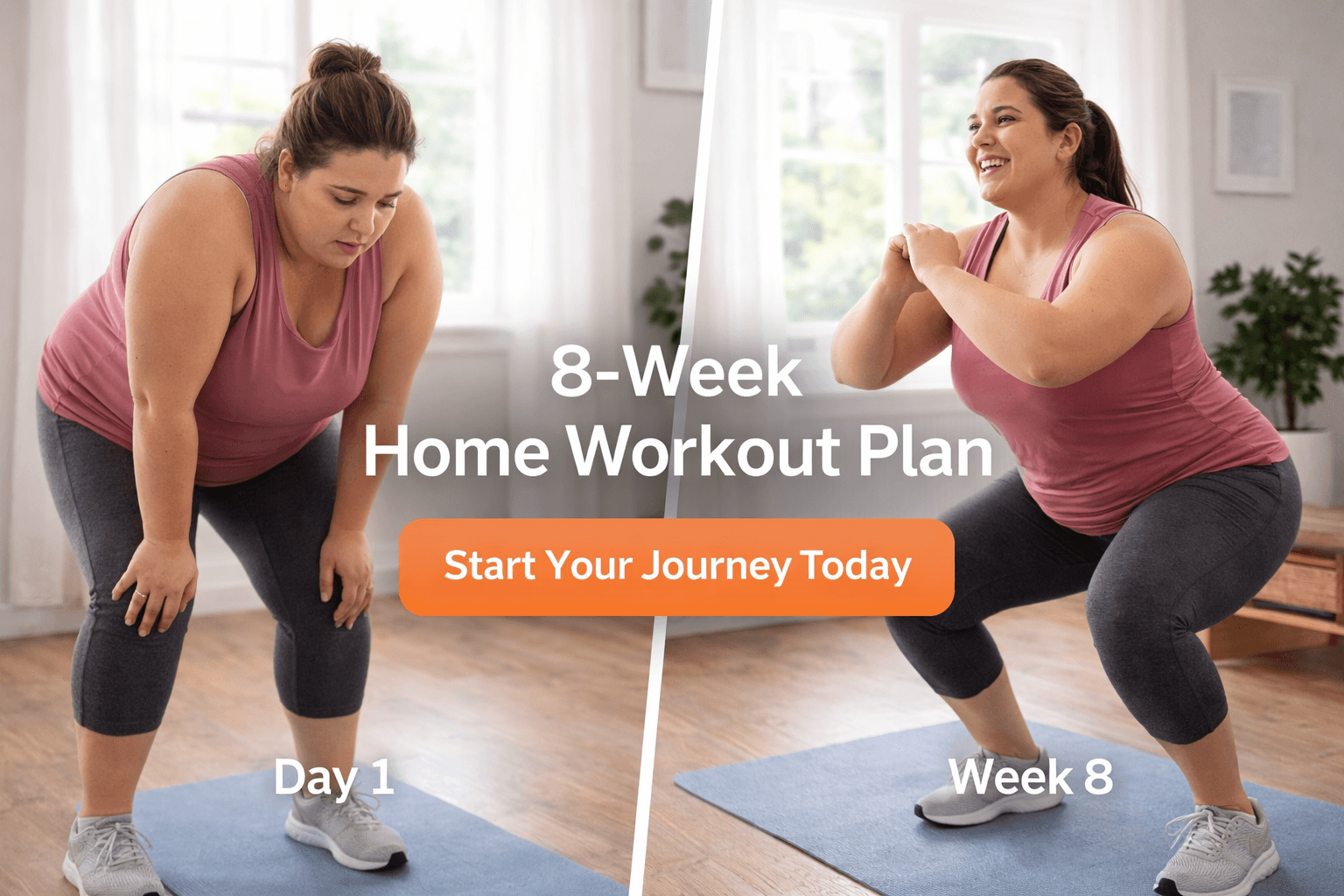
Here’s how I recommend progressing over your first 8 weeks:
Weeks 1–2: Focus purely on form. Do all exercises with bodyweight or the lightest resistance. Don’t worry about speed.
Weeks 3–4: Add a 4th rep to each set where it feels manageable. Start adding light dumbbells (5 lbs) to the squat if you’re feeling confident.
Weeks 5–6: Consider adding a 4th set to your main compound movements (squat, hip hinge, row). Increase resistance band tension.
Weeks 7–8: Add a short 10-minute walk after each session. This dramatically accelerates fat loss without adding joint stress.
By Week 8, you won’t recognize your endurance compared to Week 1. Trust the process.
Nutrition Tips That Complement This Routine
I’m not going to pretend that exercise alone is enough. After years in this space, I can tell you that nutrition does the heavy lifting (pun intended) when it comes to fat loss.
You don’t need a complicated diet. Here’s what actually works:
Prioritize protein. Aim for roughly 0.7–1g of protein per pound of body weight. Protein keeps you full, preserves muscle, and helps you recover between sessions. Eggs, chicken, Greek yogurt, cottage cheese, and legumes are your best friends.
Don’t slash calories too aggressively. A modest deficit of 300–500 calories per day is sustainable. Anything more and your body starts fighting back — fatigue, cravings, muscle loss.
Drink water before meals. One of the simplest, most evidence-backed strategies for reducing calorie intake. Two glasses before each meal can meaningfully reduce how much you eat.
Cut liquid calories first. Sodas, sweetened coffees, juices — these are calorie-dense and nearly nutritionally worthless. Swapping these out alone can create a significant deficit without changing anything else.
Common Mistakes to Avoid
After years of coaching and content creation in this space, these are the mistakes I see over and over again:
Doing too much too soon. Four or five sessions per week in week one is a fast track to burnout and injury. Start with three and earn more.
Ignoring rest days. Rest is not laziness. It’s where your body rebuilds and gets stronger. Respect it.
Comparing your progress to someone else’s. Everyone’s starting point is different. Your only competition is last week’s version of you.
Quitting after missing a session. Missing one workout means nothing. Missing three in a row is a habit forming. Get back on track, not on yourself.
Not tracking anything. You don’t need an elaborate system. Even a basic note on your phone logging what you did and how it felt is enough to spot progress and patterns.
Recommended Products for Overweight Beginners
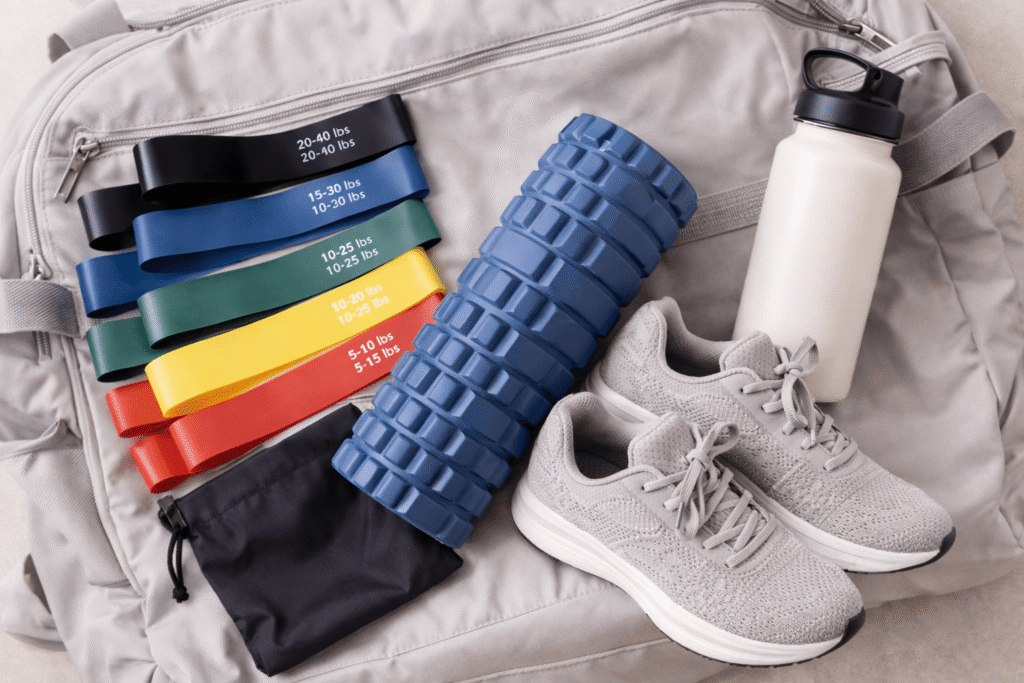
Based on my experience reviewing fitness gear for years, here are the categories worth investing in as a beginner:
Resistance Bands: Look for a set with multiple resistance levels. Fabric bands are more comfortable than the rubber loop style for lower body work. (Search “fabric resistance band set” on Amazon — typically $15–$30)
Supportive Cross-Training Shoes: If you’re carrying extra weight, a good shoe is non-negotiable for joint protection. Look for stability shoes with wide toe boxes.
Foam Roller: An underrated recovery tool. 10 minutes of foam rolling after sessions dramatically reduces next-day soreness.
Food Scale: Seriously. If you’re serious about nutrition alongside this routine, a $10 kitchen scale changes everything.
FAQ: Full Body Workout Routine for Overweight Beginners
Q: How many times a week should an full body workout routine for overweight beginners? Three times per week is the sweet spot to start. It gives you enough frequency to build momentum and see progress, while allowing adequate recovery between sessions. After 6–8 weeks of consistency, you can consider adding a fourth day.
Q: Can I do this workout if I have knee pain? Many people with mild knee discomfort do well with this routine because it avoids high-impact movements. That said, if you have diagnosed knee issues, check with your doctor or a physical therapist before starting. Chair-assisted squats are much gentler than standard squats for knee problems.
Q: How long before I see results? Most people notice improved energy and strength within 2–3 weeks. Visible physical changes typically begin around weeks 4–6, depending heavily on nutrition. Don’t use the scale as your only metric — take progress photos and note how your clothes fit.
Q: Do I need to go to the gym? Absolutely not. This entire routine can be done at home with minimal equipment. A gym can be useful down the line for adding resistance, but it’s not a requirement for beginners.
Q: Is cardio necessary alongside this strength routine? Not in the early weeks. The strength work alone will elevate your heart rate and support fat loss. From week 5 or 6 onward, adding 2–3 short walks per week is a fantastic low-impact way to increase your calorie burn.
Q: What if I can’t complete all the sets and reps? That’s completely fine — it just means you’ve found where your body currently is. Do what you can with good form, rest more if needed, and build from there. Progress, not perfection.
Q: Should I eat before working out? A light snack 30–60 minutes before — something with a little protein and carbs (like a banana with peanut butter) — works well for most people. Exercising on a completely empty stomach isn’t necessary and can leave you feeling lightheaded.
Final Thoughts
If you’ve made it to the end of this article, you’re already ahead of 90% of people who search “full body workout routine for overweight beginners” and never take action.
This routine works. It’s safe, it’s progressive, and it’s built specifically for where you are right now — not where you’ll be in a year. The most important rep you’ll ever do is the first one.
Start this week. Not Monday. Not next month. This week.
You don’t need to be perfect. You just need to be consistent.