Introduction
You’ve committed to intermittent fasting. You’ve mapped out your eating windows. You’re crushing your fast, hitting 16 hours, maybe even 18. Everything feels like it’s working until you eat something that derails the whole thing.
The frustrating part? Nobody tells you which foods to avoid while intermittent fasting until you’ve already made the mistake. You reach for what seems like a healthy choice and suddenly you’re ravenous two hours later, wondering what went wrong.
Here’s the reality: knowing what to eat is only half the battle. The other half knowing what to avoid is what separates people who get real results from those who plateau.
Most guides out there give you generic lists. “Avoid sugar.” “Skip processed foods.” But they don’t explain why these foods wreck your fast, what’s actually happening in your body, or how to navigate the gray area foods that everyone gets confused about.
This guide goes deeper. You’ll understand the science behind what breaks a fast, learn which foods are bigger saboteurs than you think, and get practical strategies for the foods that are genuinely complicated. By the end, you won’t just know what to avoid you’ll understand why it matters.
The Science of Fasting: Understanding What Actually Breaks Your Fast
How Your Metabolism Shifts When You Stop Eating
Most people think fasting is just “not eating.” But metabolically, it’s way more sophisticated than that.
When you’re eating regularly every 3-4 hours like most people do your body runs on a glucose treadmill. You eat, your blood sugar rises, insulin spikes, you store energy as fat, your blood sugar drops, you get hungry again. Repeat.
But when you fast? Something completely different happens.
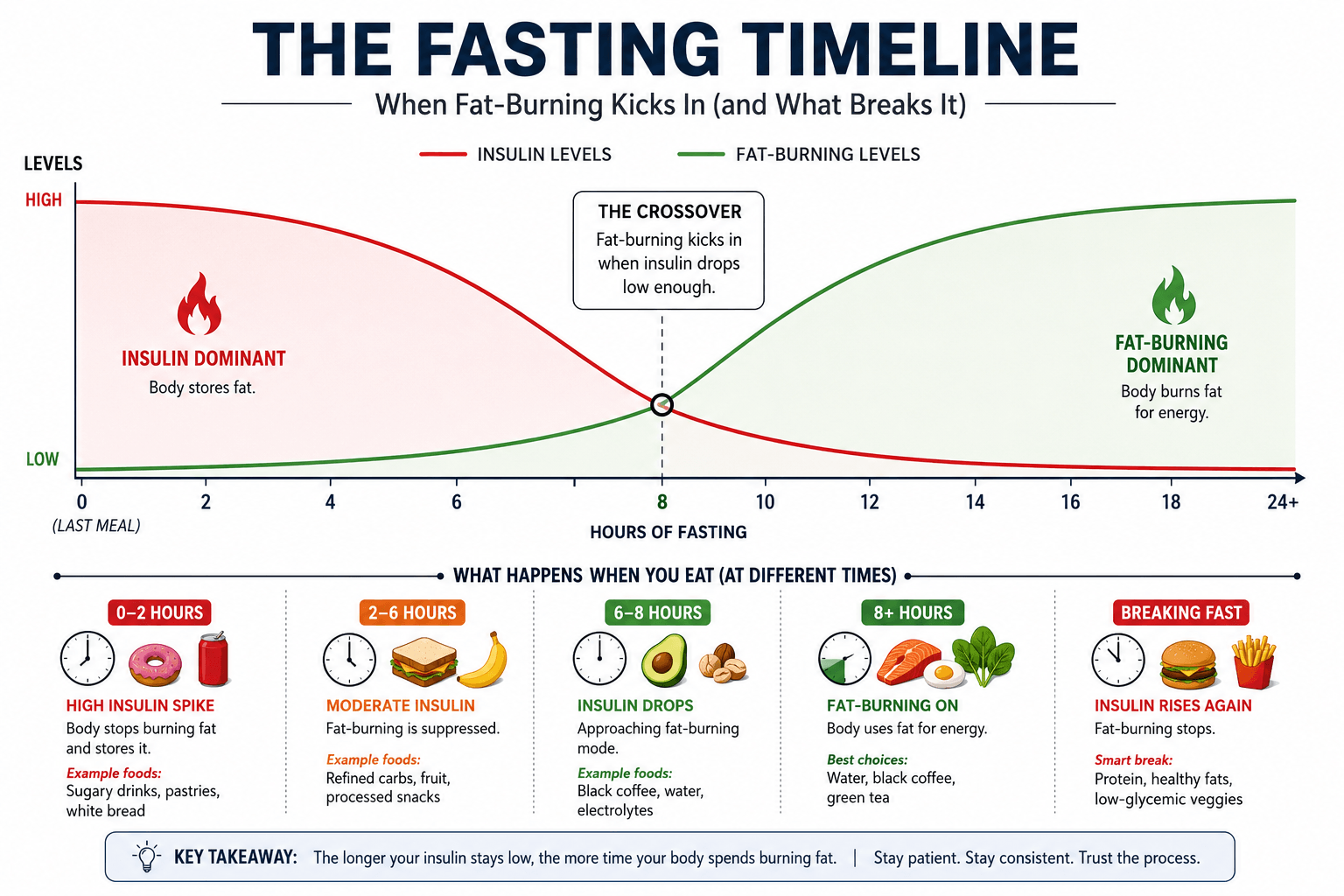
Around 12 hours into a fast, your liver glycogen starts depleting. By hour 16-24, you’ve exhausted most of your glucose reserves. That’s when your body shifts from glucose-burning to fat-burning. You enter what scientists call “ketosis lite “where your body starts using stored fat for fuel instead of glucose.
This metabolic shift is where the real benefits happen. Your insulin sensitivity improves. Your body upregulates fat-burning enzymes. You trigger cellular cleanup processes. Inflammation drops. This is the golden period you’re fasting for.
The Calorie Threshold That Actually Matters
Here’s where it gets practical: consuming any calories technically breaks a fast because it stops the metabolic state you’ve built. But there’s nuance.
Research suggests that consuming fewer than 50 calories especially from fat or protein with zero carbs might not significantly disrupt your fast. That’s why some people can have their black coffee with a teaspoon of butter and stay effectively fasted.
But 50 calories of carbs or sugar? That’s a different story. Those carbs trigger insulin, which immediately stops fat-burning and shifts your body back to glucose mode. You’ve essentially reset your fast.
The Insulin Sensitivity Cascade
This is crucial to understand: when you fast, your cells become increasingly sensitive to insulin. Your pancreas doesn’t have to work hard. Your cells eagerly accept glucose because they’ve been without it.
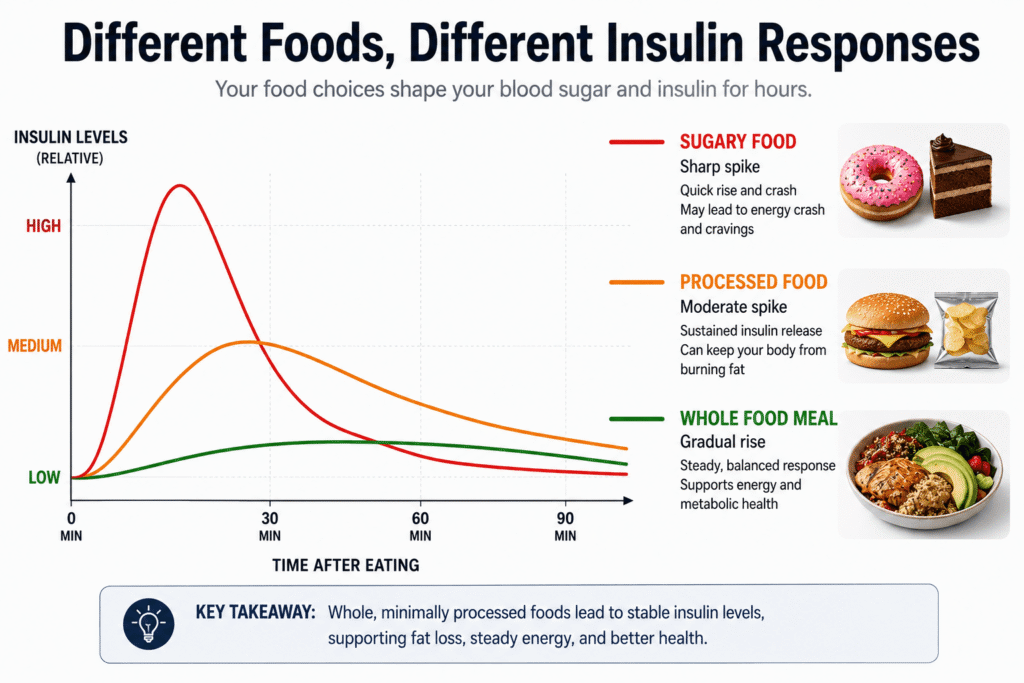
But when you consume high-glycemic foods (sugar, refined carbs, processed junk), your insulin spikes sharply. Your cells, now hyper-sensitive from fasting, accept that glucose rapidly. Your blood sugar crashes. You feel exhausted or ravenous.
You’ve not only broken your fast you’ve created a metabolic situation that makes you hungry and low-energy. That’s why people fail. It’s not about willpower. It’s about choosing foods that sabotage your body’s chemistry.
The Primary Offenders: Foods That Completely Destroy Your Fasting Window
Ultra-Processed Foods Loaded With Added Sugars
Let’s start with the obvious offender: processed foods with added sugar.
When I say processed foods, I’m talking pastries, sugary cereals, flavored yogurts, granola bars, most store-bought muffins, cookies, candy, chocolate bars, and anything with “high fructose corn syrup” on the label.
Here’s why these are so damaging to a fast:
First, they cause rapid insulin spikes. Your pancreas sees that incoming sugar and floods your system with insulin to manage it. In your fasted state, your cells are primed to accept glucose quickly, so that spike hits hard and fast.
Second, they provide zero satiety. Processed sugars get metabolized so quickly that your blood sugar crashes within 30-45 minutes. You feel hungrier after eating them than you did before. You’re essentially worse off than if you’d just waited.
Third, they trigger cravings. Sugar activates your reward centers in the brain similarly to addictive drugs. One cookie makes you want three more. It’s not a willpower problem it’s neurochemistry.
Real example: A woman I know broke her 16-hour fast with a store-bought blueberry muffin. Two hours later, she was starving. She ended up eating another 1500 calories that day because that one muffin destabilized her blood sugar. The muffin probably had 45+ grams of sugar, and her fasted metabolism couldn’t handle it.
The Sugar-Sweetened Beverage Trap
This might be the most underestimated saboteur of intermittent fasting results.
People understand that soda is bad. But what about smoothies? Iced coffee drinks? Flavored energy drinks? Fresh-squeezed juice? Even coconut water?
All of them will break your fast hard.
Here’s the problem with liquid calories: they bypass the digestion that normally slows sugar absorption. When you drink a sugary beverage, that sugar hits your bloodstream fast. Your insulin spikes harder and faster than if you’d eaten the same sugar in solid food.
A tall Frappuccino? That’s 50+ grams of sugar going straight into your system with zero fiber or protein to slow it down. Your fast is over. Your metabolism has reset.
And the problem gets worse: because it’s liquid, it provides zero satiety. You drink it, your insulin spikes, your blood sugar crashes, and you’re hungry again immediately.
Fried Foods and Heavy Processed Meats
After extended fasting, your digestive system is in a calm, efficient state. Your stomach acid is low. Your digestive enzymes are minimal.
Then you slam it with fried foods—bacon, sausage, fried chicken, french fries, onion rings.
What happens? Bloating. Digestive distress. Inflammatory responses. Your gut flora gets irritated. You feel uncomfortable, sluggish, sometimes even nauseous.
This is especially true with processed meats that contain added sugars and nitrates. Your fasted digestive system isn’t ready for that assault.
That said, a reasonable portion of high-quality protein grilled chicken, fresh fish, lean ground turkey is perfect for breaking a fast. It’s the preparation method and the additives that matter.
The Gray Zone: Foods That Kind of Break Your Fast (And What the Science Actually Says)
Artificial Sweeteners: The Controversial Middle Ground
This is where people get genuinely confused, and for good reason. The research is mixed.
Technically, artificial sweeteners contain zero calories and don’t spike insulin significantly. Studies show that aspartame, sucralose, and most other non-nutritive sweeteners don’t trigger major insulin responses in most people.
So diet soda during your fast won’t technically break it, right?
Not exactly.
Recent research suggests that artificial sweeteners might affect your gut microbiome in ways that impact metabolic health. They also perpetuate the habit of craving sweet tastes, which makes fasting harder psychologically. You’re satisfying a craving without actually satisfying it—setting yourself up for future cravings.
Additionally, some people do have metabolic responses to certain sweeteners. Individual variation is real. What doesn’t affect your friend might affect you.
My practical recommendation: During your actual fasting window, avoid artificial sweeteners. Your fast is a finite period—usually 16-18 hours. Go without sweet tastes for that time. It resets your palate and reduces cravings. Save diet drinks for your eating window if you want them.
Milk in Your Coffee (The Calorie Question)
A splash of milk in your black coffee. Seems harmless, right?
Here’s the math: a tablespoon of whole milk has about 0.6 grams of carbs (lactose) and 0.5 grams of fat. That’s roughly 5 calories.
Technically, 5 calories won’t spike your insulin. Your fast isn’t “broken” in the strict metabolic sense.
But and this is important you’re no longer doing a true fast. You’ve consumed calories. Your digestive system has engaged slightly. You’re in a gray zone.
If your goal is weight loss and general health benefits, a splash of milk probably won’t derail you. If your goal is maximum autophagy and cellular repair (benefits that kick in more during longer, stricter fasts), then even that small amount matters.
My take: Know the difference. Black coffee is a true fast. Coffee with cream is technically breaking it, even if minimally. Choose based on your actual goals, not what seems “close enough.”
Alcohol: The Metabolic Disruptor Nobody Talks About
Here’s something most fasting guides skip: alcohol.
Alcohol has calories (7 per gram). It also triggers metabolic responses. When you consume alcohol, your liver prioritizes processing it over everything else including fat-burning.
Drinking wine during your eating window? That’s fine. Your body is in eating mode.
But some people think they can have a glass of wine or a light beer during their fasting window because it’s low-calorie. That’s a mistake.
Alcohol disrupts your fasted state. It stops fat-burning. It can increase hunger and lower inhibitions around food choices. You might think one beer is fine, but then you eat a bag of chips because alcohol removed your impulse control.
Save alcohol for your eating window. Your fast is too valuable to compromise.
Timing Matters: When You Break Your Fast Is As Important As What You Eat
The First Meal Myth: Why Breaking Your Fast “Correctly” Matters
A lot of guides say you need to break your fast with something light. That’s not entirely wrong, but it’s incomplete.
When you’ve been fasting for 16+ hours, your stomach is calm, your digestive enzymes are minimal, and your metabolism is in a specific state. You can’t just slam it with heavy food without consequences.
But here’s what actually matters: the composition of that first meal.
If you break your fast with a bowl of white rice and soy sauce? Your blood sugar will spike. You’ll get hungry again quickly.
If you break your fast with eggs, vegetables, and whole grains? Your blood sugar rises gradually. You stay satisfied for hours.
The science: A meal that combines protein + healthy fat + complex carbs + fiber creates a slow, stable glucose curve. Your insulin rises gradually, your cells absorb the glucose slowly, your blood sugar doesn’t crash, and you stay satisfied.
Breaking your fast with a meal like this actually extends many of the fasting benefits because you’re not creating inflammatory blood sugar spikes.
Practical example: Compare two breaking-fast scenarios:
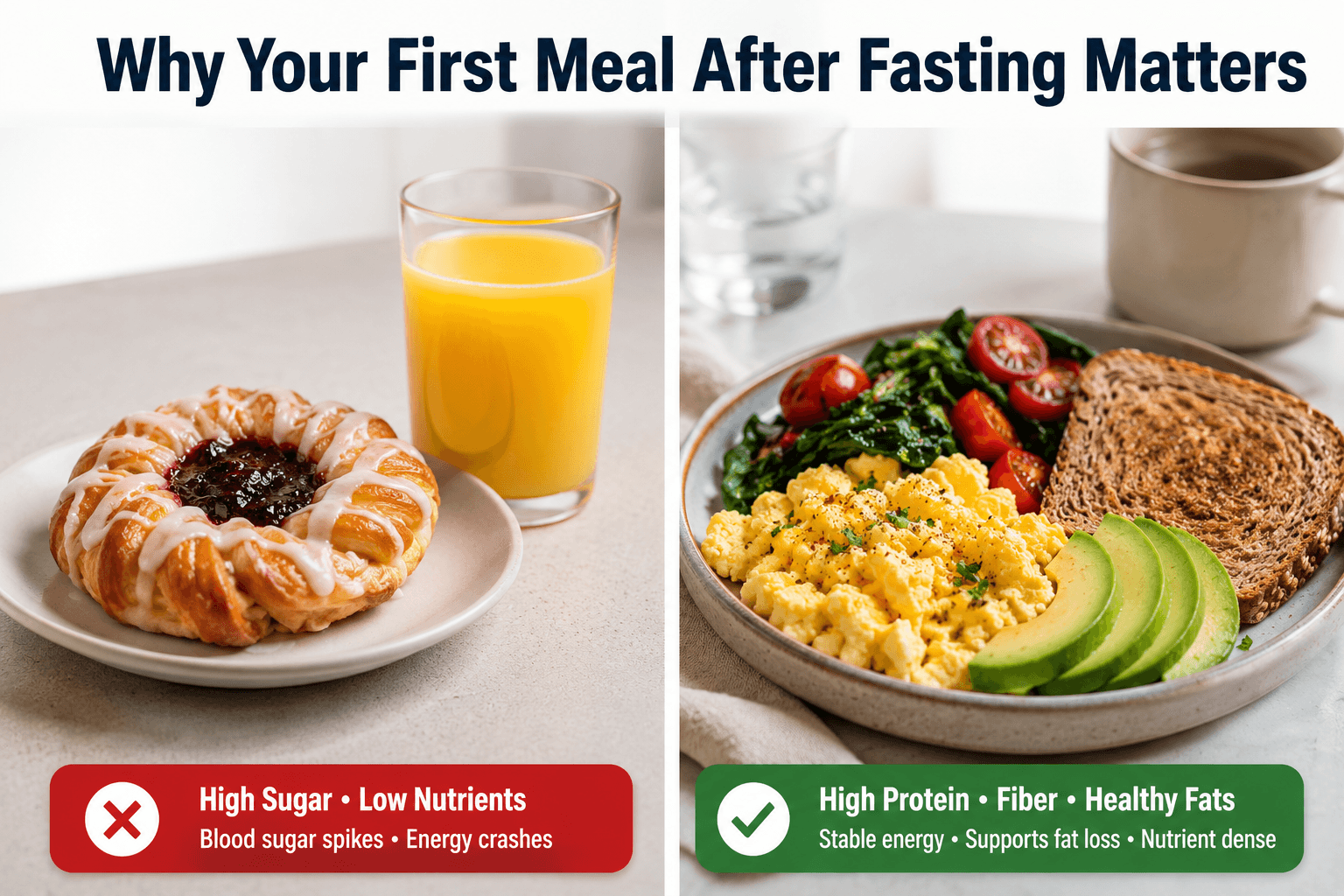
Scenario A: Orange juice and a bagel. Total: 65g carbs, 3g protein, 1g fat. Blood sugar spikes, crashes in 2 hours, you’re ravenous.
Scenario B: Scrambled eggs with whole wheat toast, avocado, and berries. Total: 35g carbs, 20g protein, 15g fat. Blood sugar rises gradually, stays stable for 4+ hours, you’re satisfied.
Same eating window started. Completely different metabolic outcomes.
The Meal Timing Window: When to Eat Your “Breaking Fast” Meal
Here’s something else people get wrong: when you eat that first meal actually impacts the rest of your eating window.
If you break your fast at 12 PM with a healthy meal, then wait 1-2 hours before eating again, your body stabilizes. You get one meal, then hunger comes back naturally.
But if you break your fast at 12 PM and immediately start snacking because “eating window is open now,” you’re not giving your body time to feel satisfied. You’ll overeat.
Pro move: break your fast with a solid, satisfying meal. Wait at least 1-2 hours before eating again. This mimics natural eating patterns and prevents the “floodgates opened” mentality that ruins results.
The Psychology of Fasting: Why People Choose the Wrong Foods
The Hunger Hormone Isn’t Always Actual Hunger
Your body produces ghrelin, the “hunger hormone.” It follows a predictable pattern throughout the day, spiking around times you normally eat.
Here’s the trick: ghrelin spikes don’t always mean you’re actually hungry. Your body is just used to eating at certain times. It’s expecting food.
When you’re fasting and that ghrelin spike hits, you feel hungry. But if you distract yourself, the hunger typically passes in 15-20 minutes. Your body isn’t actually depleted it’s just expecting food on schedule.
But here’s where it gets dangerous: when you do break your fast, if you eat something that doesn’t satisfy (like processed foods), you’re training your body to crave more. You’re in a worse position than if you’d just waited through that hunger.
The Compensation Trap: Why “Earned It” Thinking Backfires
I see this constantly: people fast for 18 hours and think, “I’ve earned a treat. I can eat whatever I want during my eating window.”
The problem is, whatever you want usually isn’t nutritious. It’s processed, sugary, calorie-dense junk.
You’re not earning anything. You’re sabotaging the benefits of your fast.
Here’s the math that people avoid: if you fast for 18 hours and then eat 3000 calories of processed food (which is surprisingly easy), you’re in a calorie surplus for the day. Your body hasn’t lost weight. You’ve actually created a metabolic situation where you’re more likely to store fat because you’ve spiked insulin after a fasted state.
Meanwhile, if you’d eaten 2000 calories of real food during your eating window, you’d be in a slight deficit while maintaining the fasting benefits. That’s where real results happen.
Stress Eating and the Fasting Paradox
Extended fasting can increase cortisol (your stress hormone) if you’re not careful. When cortisol rises, your body craves high-calorie, sugary, fatty foods evolutionarily, this made sense. High stress = prepare for scarcity = eat calorie-dense food.
But in modern life, this means that fasting sometimes makes you crave junk harder.
If you find yourself ravenously wanting processed foods when you break your fast, that might be cortisol-driven hunger, not actual hunger. The solution: stress management, not more food. Meditation, walking, stretching these lower cortisol and reduce cravings.
What to Eat Instead: The Framework for Breaking Your Fast Successfully
The Macro Framework That Actually Works
When you break your fast, aim for a meal that includes:
- Protein: 25-35g (eggs, fish, chicken, Greek yogurt, tofu)
- Healthy fat: 10-20g (avocado, olive oil, nuts, fatty fish)
- Complex carbs: 30-50g (brown rice, sweet potato, oats, quinoa)
- Fiber: 8-12g (vegetables, whole grains, legumes)
This combination creates stable blood sugar, high satiety, and prevents the crash that leads to cravings.
Real breaking-fast meals:
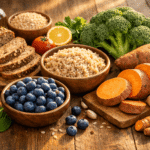
- 3 eggs with whole wheat toast, avocado, and spinach
- Grilled salmon with sweet potato and roasted broccoli
- Greek yogurt (unsweetened) with berries, granola (minimal sugar), and almonds
- Chicken breast with quinoa and mixed vegetables
Notice none of these are complicated. They’re simple, whole foods that your body recognizes and processes efficiently.
What NOT to Eat When Breaking Your Fast
In contrast, here’s what destroys your progress:
- Bagels, pastries, donuts
- Sugary cereals or granola
- White bread or white rice
- Sugary drinks (juice, soda, even smoothies)
- Fried foods
- Most restaurant food (high sodium, hidden sugars, processed oils)
These foods spike your insulin, crash your blood sugar, make you hungry again within 2 hours, and undo your fasting benefits.
Affiliate Recommendations: Tools That Actually Support Fasting Success
1. High-Quality Electrolyte Powder
If you’re doing fasts longer than 16-18 hours, electrolytes become important. Fasting causes you to lose sodium and potassium. Extended electrolyte loss leads to fatigue, headaches, and the “fasting flu.”
Why I recommend it: Zero calories, actually prevents the symptoms that make people break their fast prematurely due to feeling terrible.
Look for: No sugar, no artificial sweeteners, clean ingredients (sodium, potassium, magnesium).
Try [ LMNT or Liquid IV electrolyte brand]
2. Food Tracking App With Community Features
I used to think food tracking was obsessive. Then I realized it’s actually transparency.
When you log what you eat, you see patterns. You realize how often you’re eating sugary foods. You see your actual calorie intake versus your assumptions. That visibility changes behavior.
Why I recommend it: Most people dramatically underestimate how much they’re eating, especially during eating windows. Tracking removes guesswork.
Look for: Something with a large food database, barcode scanning, and ideally community features where you see what others eat.
Try: [ My Fitness Pal, Cronometer, or Macros]
3. MCT Oil Powder (For Strategic Use)
MCT oil won’t spike insulin, but it does contain calories. It’s a gray-zone food.
Here’s where it’s actually useful: on days when you do intense exercise, adding MCT oil to your first meal after fasting provides clean energy without the blood sugar spike of carbs.
Why I recommend it: Pure energy source that your brain and body use immediately. No digestion required, no blood sugar disruption.
Look for: Organic, C8/C10 blend, no additives.
Try: [ Bulletproof, Perfect Keto, or similar brand]
The Pros and Cons of Different Fasting Approaches
| Approach | Pros | Cons |
|---|---|---|
| Strict Fasting (water, black coffee only) | Maximum metabolic benefits, cellular repair, clear fasting state | Psychologically harder, less flexible, harder to sustain long-term |
| Relaxed Fasting (under 50 cal drinks allowed) | More sustainable, easier to stick to, most benefits preserved | Slightly less metabolic advantage, potential for scope creep (“If this is okay, maybe…”) |
| Eating window focused | No restriction on what foods, easier adherence, psychological freedom | Requires discipline during eating window, easy to overeat junk |
| Macro-focused (hitting specific ratios) | Optimized nutrition, sustained satiety, clear progress | More work, requires tracking, less intuitive |
The reality: The best approach is the one you’ll actually stick to. Perfection you can’t maintain beats optimization you quit.
FAQ: Real Questions About Foods to Avoid While Intermittent Fasting
1. Does zero-calorie gum break my fast?
Technically no zero calories means zero metabolic impact. But chewing stimulates digestive enzymes and can increase hunger, making your fast harder. Skip gum during fasting windows. Save it for your eating window.
2. What about black coffee versus coffee with cream?
Black coffee: zero calories, zero impact, true fast.
Coffee with cream: technically breaks your fast even with just a splash (roughly 5-10 calories). But for most people’s fasting goals, this minimal impact is acceptable. Know the difference and choose consciously.
3. Is coconut water a good way to break a fast?
No. Coconut water has 9-12 grams of carbs and sugar per serving. It’ll spike your insulin exactly the way you don’t want. Stick with regular water.
4. Can I eat fruit during my eating window?
Yes, but strategically. Fruit has natural sugars, so combine it with protein or fat. Apple with almond butter? Perfect. Apple juice? No liquid sugar hits too fast.
5. What about “healthy” granola or protein bars?
Check the label. Most granola bars have 15-25g of sugar and heavily processed ingredients. They’re basically candy bars in health-conscious clothing. Avoid them unless you’re eating during your window and can afford the sugar spike.
6. How quickly does my body recover if I accidentally eat something that breaks my fast?
Your fasted metabolic state stops immediately upon consuming calories. But the benefits don’t vanish. If you break your fast at hour 14, you’ve still had 14 hours of fasting benefits. Just reset and continue from there. One mistake doesn’t erase weeks of progress.
7. Can I have alcohol during my eating window?
Yes, but understand what happens: alcohol has 7 calories per gram, and your liver prioritizes processing it over everything else including fat-burning. One drink during eating is fine. Getting drunk will derail your progress because you lose impulse control around food choices.
The Real Cost of Choosing the Wrong Foods
Let me be direct about something: the foods you choose during your eating window are the difference between fasting being a success or a failure.
You can crush your fast for 16 hours. You can show discipline. You can stick to the schedule.
But if you break it with processed junk, you’ve wasted your time.
Here’s what happens:
- Your insulin spikes
- Your blood sugar crashes within 2 hours
- You’re hungrier than you’d be if you’d eaten real food
- You overeat during your eating window
- You end the day with a calorie surplus
- You haven’t lost weight
Meanwhile, someone who fasted for 14 hours and ate real food during their eating window lost weight and feels great.
The fasting isn’t the magic. The fasting combined with smart eating is the magic.
Conclusion
Knowing which foods to avoid while intermittent fasting is the second half of the equation that determines your success.
You can nail your fasting windows, but if you’re eating processed junk, sugary drinks, and fried foods when you do eat, you’re working against yourself. You’ll feel worse, crave more, and see minimal results.
The foods that truly sabotage your fast are the ones that spike your insulin: processed sugars, sugary beverages, refined carbs, and fried foods. Avoid these. Full stop.
The gray-zone foods—artificial sweeteners, milk in coffee, alcohol require conscious choice based on your specific goals. Know the difference, decide consciously, and don’t convince yourself that “close enough” is the same as actually fasting.
When you break your fast, eat real food. Protein, vegetables, healthy fats, complex carbs. Give your body actual nutrition after fasting, not empty calories. This simple shift is what transforms intermittent fasting from a strategy people try and quit into a lifestyle that delivers real results.
Start with this: identify one category of foods you consistently reach for that you know sabotages your fast. Cut it for the next two weeks. Notice how your fasting gets easier, how your energy stays stable, and how your results actually show up.
That’s when you’ll understand that what you don’t eat might be more important than what you do.
Images to Add (AI Prompts)
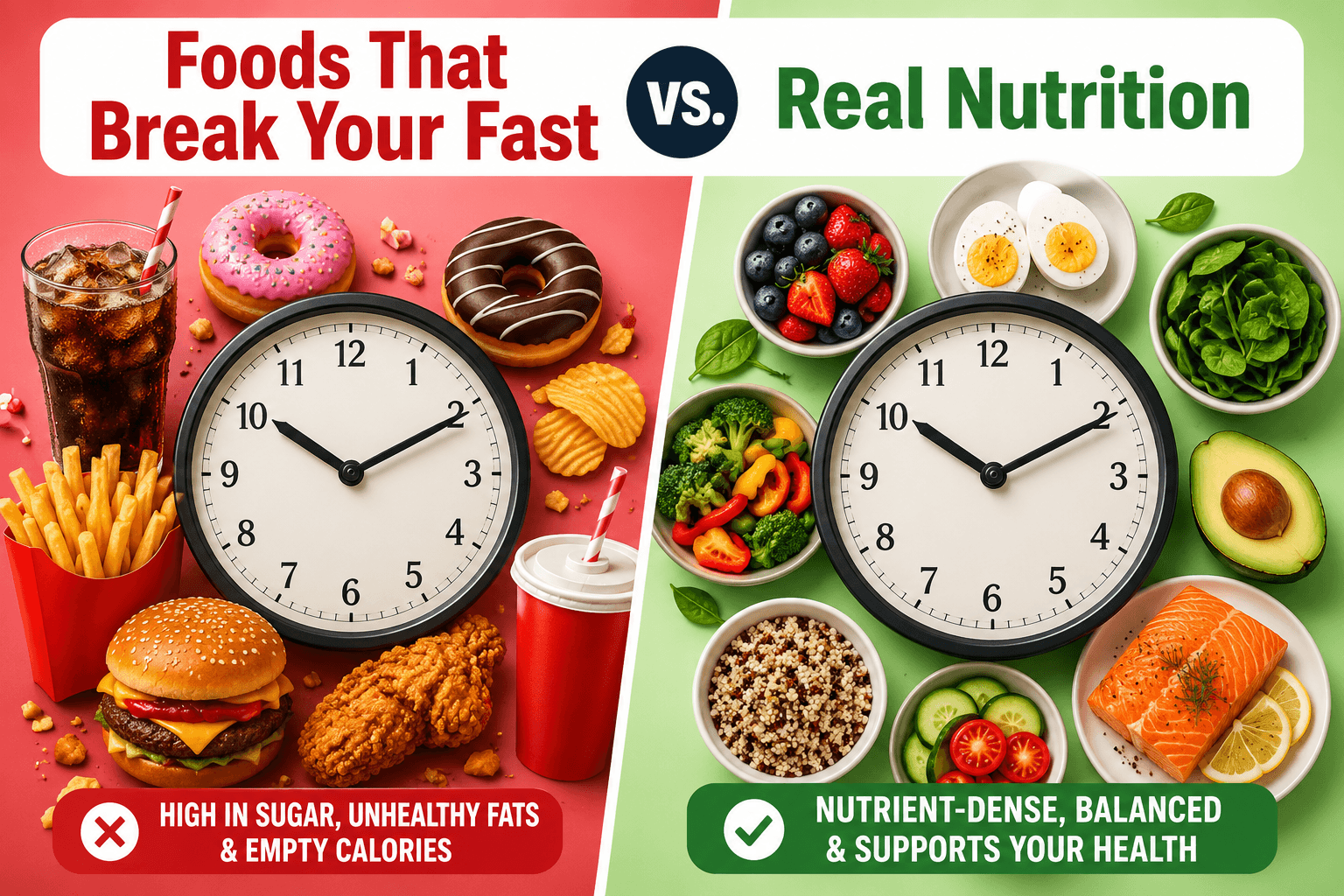
- Hero Image: Split-screen comparison—left side shows a clock face with unhealthy foods around it (soda, donuts, fries), right side shows the same clock with healthy foods (eggs, vegetables, fish). Bright, clean design. Caption: “Foods That Break Your Fast vs. Real Nutrition”
- Metabolic State Diagram: Timeline showing hours of fasting on X-axis, insulin and fat-burning levels on Y-axis. Show the moment they intersect where fat-burning kicks in. Include annotations for what happens when you eat different foods at different times. Educational, minimalist style.
- Breaking-Fast Meal Comparison: Side-by-side photos—left shows unhealthy breaking-fast meal (pastry, juice, nothing else), right shows nutrient-dense breaking-fast meal (eggs, vegetables, whole grain toast, avocado). Real photography, appetizing, high-quality. Caption: “Why Your First Meal After Fasting Matters”
- Insulin Response Graph: Three lines showing insulin response to: sugary food (sharp spike), processed food (medium spike), whole food meal (gradual rise). Clean, easy-to-read, use contrasting colors. Caption: “Different Foods, Different Insulin Responses”